Serving West Haven, Weber County & the Wasatch Front
2566 S 3150 W, West Haven, UT 84401

Pipe Types We Work With in West Haven & Weber County, UT

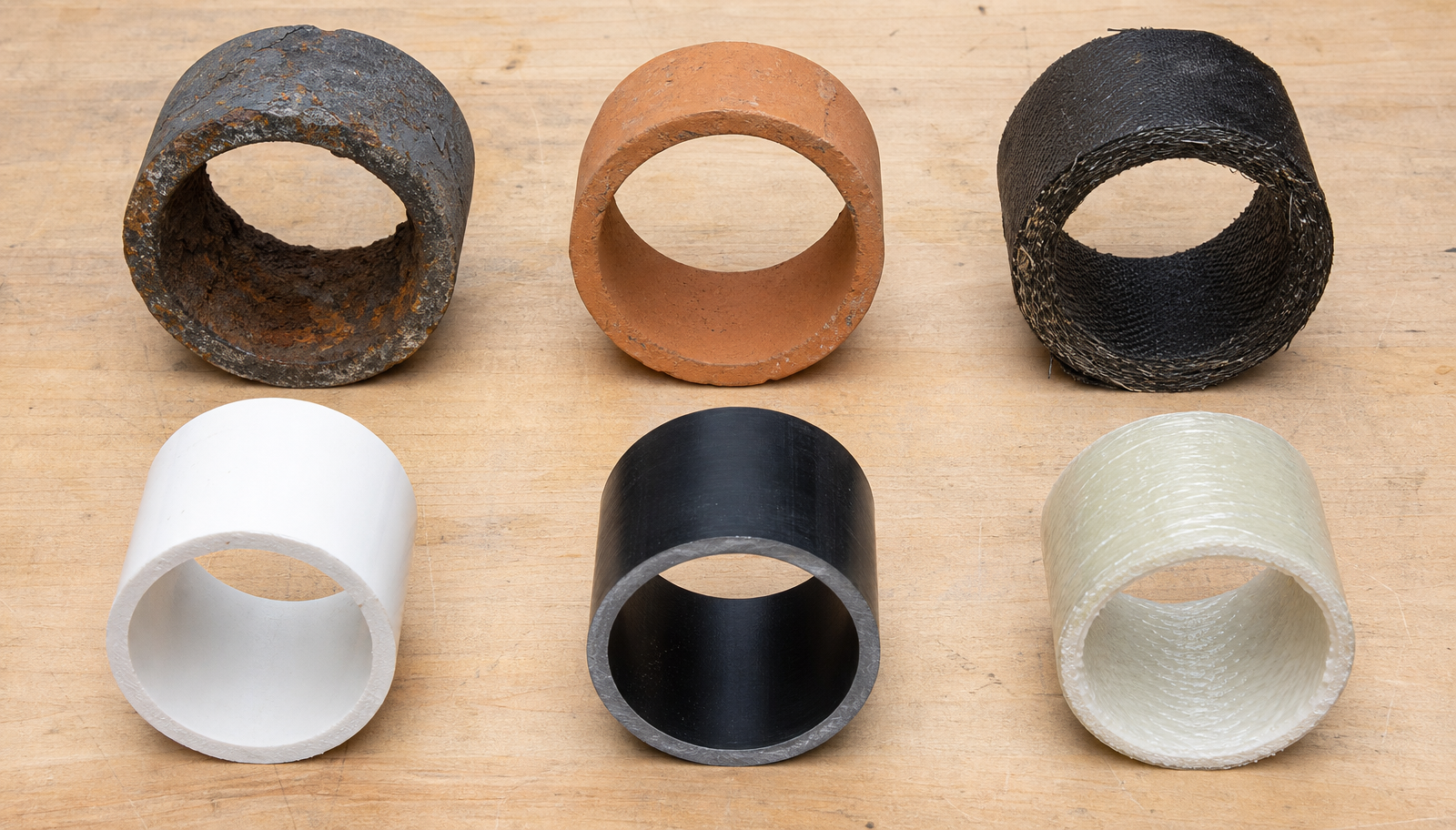
The pipe material running beneath your Weber County property has a direct impact on how it fails, what warning signs to watch for, and which trenchless repair method is most appropriate. Weber County’s housing stock spans over a century of residential development — from Ogden’s oldest neighborhoods with vitrified clay and early cast iron systems to the newer developments in Farr West and Plain City with modern plastic pipe. Each era brought different materials, and each material ages differently. At Rhino Rooter, we work with every pipe type found throughout the Wasatch Front — and we know exactly how to fix each one without digging up your property.

Pipe Types

Why Pipe Material Matters in Weber County

Weber County's underground pipe environment is more demanding than most. Utah's dramatic seasonal freeze-thaw cycles place stress on buried pipe joints year after year, accelerating the failure modes of every pipe material. The region's notoriously hard water — carrying high concentrations of calcium and magnesium — compounds deterioration in metal pipes, adding scale buildup that narrows pipe interiors and weakens walls from the inside. And the significant stock of post-war residential development throughout Ogden, Roy, and South Ogden means many properties are still running on 60 to 70-year-old pipe systems that were never designed to last this long.

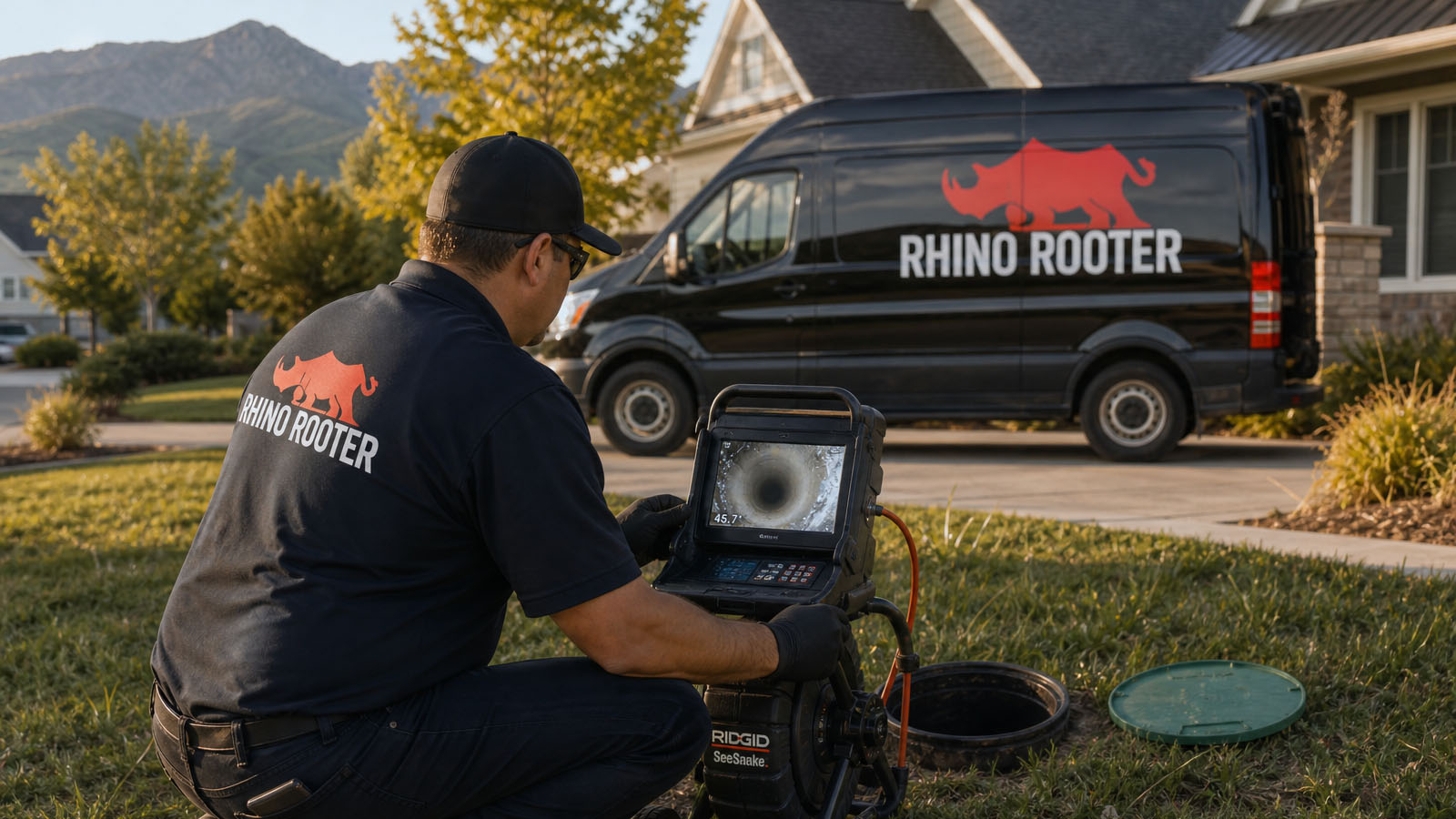
Understanding what your pipes are made of — and what condition they are in — is the foundation of every repair decision we make. Our CCTV sewer camera inspection identifies pipe material, condition, and damage type before any recommendation is offered.

Cast Iron Sewer Pipe Repair

Cast iron was the standard material for residential and commercial sewer systems from the early 1900s through the 1970s — which means it is the most prevalent aging pipe material throughout Ogden, Roy, South Ogden, and Harrisville's established neighborhoods. Built to be durable, cast iron sewer lines have served Weber County properties well. But after 50 to 70 years of continuous use in Utah's demanding conditions, many of these lines are reaching or exceeding the end of their reliable service life.

How cast iron fails in Weber County

Cast iron corrodes from the inside out through a process called hydrogen sulfide corrosion — sewer gases react with the pipe interior to produce sulfuric acid, which gradually eats away the pipe wall. This process produces heavy internal scale buildup that progressively narrows the pipe diameter and restricts flow. In Weber County, Utah's hard water accelerates this process significantly — the calcium and magnesium minerals in the water supply deposit as scale on the corroding pipe interior, compounding the narrowing effect and creating a particularly dense buildup that standard drain cleaning methods struggle to remove.

Freeze-thaw ground movement adds another layer of stress. As the soil around buried cast iron pipes expands and contracts with Utah's seasonal temperature swings, pipe joints shift and open — creating the gaps that allow root intrusion and groundwater infiltration to begin.

Warning signs of cast iron pipe deterioration

Slow drains throughout the property (not just one fixture)
Rust-colored water or sediment in drain water
Frequent blockages from scale accumulation inside the pipe
Foul odors from cracked joints allowing sewer gas to escape
Visible rust staining on any exposed sections of cast iron pipe

Our Trenchless Solution

CIPP lining is the ideal solution for deteriorating cast iron with remaining structural integrity. We install a resin-saturated liner inside the existing cast iron pipe and cure it in place — creating a smooth, corrosion-resistant new pipe within the old one that is impervious to the hydrogen sulfide corrosion and hard water scaling that destroyed the original. For cast iron that has experienced significant structural failure, pipe bursting replaces the full line with durable HDPE pipe.

Ductile Iron Pipe Lining & Repair

Ductile iron pipe is a stronger, more flexible evolution of traditional cast iron, introduced in the 1950s and widely used through the following decades for water mains, force mains, and larger diameter sewer applications. While more resilient than standard cast iron, ductile iron is not immune to the corrosion, joint deterioration, and long-term degradation that affect all metal pipe materials.

How Ductile Iron Fails

Like cast iron, ductile iron is susceptible to internal hydrogen sulfide corrosion and external corrosion from aggressive or moisture-rich soils. A particular failure mode in older ductile iron is graphitization — where the iron corrodes internally while leaving a brittle graphite shell that appears structurally intact on the outside. In Weber County, where soil moisture from the Ogden and Weber rivers and their tributaries is prevalent in many low-lying areas, external corrosion can progress faster than in drier environments.

Common applications in Weber County

Ductile iron is more prevalent in municipal water mains, commercial properties, and larger diameter infrastructure than in typical residential drain lines. Ogden's industrial and railroad heritage means the city has more ductile iron in its commercial and utility infrastructure than most suburban Weber County communities.

Our Trenchless Solution

CIPP lining provides effective structural rehabilitation for ductile iron pipes, addressing both internal corrosion and joint deterioration in a single operation. For larger diameter ductile iron sections requiring full replacement, pipe bursting is a viable option depending on pipe diameter and site conditions.

HDPE Pipe Repair & Services

High-density polyethylene pipe — HDPE — is the modern standard for trenchless sewer replacement and new residential installations. It is the material we install when performing pipe bursting throughout Weber County, and its performance characteristics make it the best available option for replacement pipe in Utah's demanding climate.

Why HDPE is ideal for Weber County's conditions

Freeze-thaw resilient — HDPE's flexibility allows it to accommodate the ground movement from Utah's seasonal temperature swings without cracking or joint failure — a critical advantage over rigid pipe materials in the Wasatch Front's climate
Hard water immune — completely corrosion-proof and unaffected by Utah's calcium-rich water supply; no scale buildup, no wall thinning, no pipe interior degradation
Seamless fused joints — thermally fused connections give roots no entry points and groundwater no infiltration gaps
100+ year service life — far outlasting any pipe material it replaces
Superior flow characteristics — the smooth interior delivers better flow than even new cast iron or clay

When HDPE Repair Is Needed

While HDPE is the most durable pipe material available, it is not entirely immune to damage. Mechanical damage during installation, improper fusion joints, or significant ground subsidence can cause issues. We inspect HDPE lines using camera equipment and address any localized issues with targeted repairs.

HDPE as Replacement Pipe

When we perform pipe bursting on cast iron, clay, or Orangeburg lines throughout Weber County, the replacement pipe we install is always HDPE — giving Weber County homeowners a pipe system that will far outlast whatever it replaces.

Orangeburg Pipe Replacement

If there is one pipe material that demands urgent attention when discovered in a Weber County property, it is Orangeburg. Named after Orangeburg, New York where it was manufactured, Orangeburg pipe is made from compressed layers of ground wood pulp and pitch — a cheap wartime substitute for cast iron that was installed widely in homes built between the 1940s and 1960s. In Weber County's post-war residential neighborhoods — particularly in Roy, central Ogden, and South Ogden where the housing boom of that era was concentrated — Orangeburg pipe remains in active service beneath thousands of properties.

It was never designed to last more than a generation. In most cases throughout Weber County, that deadline passed decades ago.

How Orangeburg Fails

Orangeburg does not corrode — it absorbs moisture and deforms. Over decades underground, the material softens, loses its round shape, and collapses under the weight of the surrounding soil. A camera inspection of an Orangeburg line in a Roy or South Ogden home often reveals a pipe cross-section that has deformed from round to oval to nearly flat — a crushed pipe still in daily use.

Utah's climate accelerates this process. The freeze-thaw cycles that stress every buried pipe material are particularly damaging to Orangeburg — the repeated expansion and contraction of surrounding soil compresses the already-softening material further with every winter.

Orangeburg cannot be reliably lined. The only solution is replacement.

A deformed Orangeburg pipe does not provide the consistent round interior that a CIPP liner requires to adhere and cure correctly. Attempting to line a significantly deformed Orangeburg line risks liner failure — which is why pipe bursting is the definitive solution for Orangeburg replacement throughout Weber County.

Warning signs of Orangeburg pipe problems

Slow drains throughout the property with no obvious blockage cause
Frequent sewage backups in lower fixtures
Sewer odors inside or around the home
Soft, wet spots in the yard over the sewer line path
Camera inspection revealing an oval or flattened pipe cross-section

Our Trenchless Solution

Pipe bursting is the most effective method for Orangeburg replacement. The bursting head fractures and displaces the deteriorated Orangeburg material as it pulls a new HDPE pipe into place — a single, efficient operation that replaces the failed pipe completely. Because Orangeburg is soft and degrades easily, it responds well to the bursting process.

If you own an older home in Roy, central Ogden, or South Ogden that has never had its sewer line inspected, Orangeburg is a genuine possibility. A camera inspection is the only way to confirm its presence and assess its current condition.

Plastic Sewer Pipe Repair

Plastic pipe — primarily PVC and ABS — became the standard for residential drain, waste, and vent installations from the 1970s onward, replacing cast iron and clay in new construction throughout Weber County. Lighter, less expensive, and easier to install, plastic pipe quickly became the material of choice for new residential builds in communities like Farr West, Plain City, North Ogden, and Pleasant View as those areas developed through the latter decades of the 20th century.

How plastic pipe fails in Weber County

Plastic pipe is durable but not without its vulnerabilities — and several of those vulnerabilities are particularly relevant in Weber County's environment:

Joint separation from freeze-thaw movement — Utah's seasonal ground movement places repeated stress on plastic pipe connections; push-fit and improperly solvent-welded joints can separate over time
Pipe bellying from ground settling — in newer residential developments where ground has not fully settled, plastic pipe can sag between support points, creating low spots where waste accumulates
Root intrusion at gasket connections — rubber gasket joints in PVC pipe can degrade and allow roots to enter over time
UV and physical damage — exposed PVC sections degrade in Utah's strong sunlight; shallow-buried sections are vulnerable to cracking from ground pressure or frost

Our Trenchless Solution

For plastic pipe with cracked sections, joint separation, or structural issues, CIPP lining is an effective rehabilitation option. For pipes with severe bellying or complete joint failure, pipe bursting provides full replacement. Camera inspection identifies the precise nature and location of the problem before any repair is performed.

Reinforced Concrete Pipe Lining

Reinforced concrete pipe is used primarily in larger diameter municipal, stormwater, and commercial sewer applications. It is a heavy-duty material designed for high-volume flow and significant structural loads — but it is susceptible to a specific set of deterioration problems that can compromise the entire pipe structure over time, particularly in Weber County's climate.

How reinforced concrete pipe fails

Hydrogen sulfide corrosion — the same sulfuric acid reaction that attacks cast iron is highly destructive to concrete, eating away the pipe crown from the inside and exposing the reinforcing steel beneath
Joint deterioration — mortar-sealed joints crack and open from freeze-thaw ground movement, allowing groundwater infiltration and root intrusion
Spalling and delamination — the concrete surface breaks away under corrosive conditions, eventually exposing and corroding the internal steel reinforcement
Structural cracking — from heavy surface loads, inadequate bedding support, or freeze-thaw movement in the surrounding soil

Our Trenchless Solution

CIPP lining is the industry-standard solution for reinforced concrete pipe rehabilitation. A structural liner installed inside the deteriorated concrete restores the pipe’s internal integrity, seals all joints, and provides a corrosion-resistant surface that extends the pipe’s service life significantly. This is particularly relevant for Weber County’s municipal storm drainage infrastructure and commercial sewer systems in Ogden’s older commercial and industrial districts.

Steel Casing Pipe Services

Steel casing pipe is used in utility construction as a protective sleeve through which carrier pipes — sewer, water, gas, and conduit — are installed beneath roads, railways, and other obstacles using directional boring or pipe jacking methods. While not a sewer pipe itself, steel casing plays a critical role in protecting carrier pipes at key crossing points throughout Weber County's utility infrastructure.

Steel casing in Weber County

Ogden's historic role as a railroad hub — the location of the transcontinental railroad's Golden Spike connection point — means the city and surrounding area have an unusually dense network of rail infrastructure. Where sewer, water, and utility lines cross beneath Union Pacific and other rail corridors throughout the Ogden area, steel casing pipe installations are common. Road crossings beneath Weber County's highway network similarly rely on steel casing for carrier pipe protection.

Our Services for Steel Casing

We have experience working with steel casing installations in commercial, municipal, and utility applications throughout the Weber County and Wasatch Front area. Our camera inspection capabilities allow us to assess carrier pipe conditions within casings, and we can address carrier pipe issues using appropriate trenchless methods based on pipe type and access configuration.

Vitrified Clay Pipe Replacement & Lining

Vitrified clay pipe is among the oldest sewer materials still in active service in Weber County — found beneath the streets and properties of Ogden's oldest neighborhoods, Brigham City's historic residential sections, and other communities established in the late 19th and early 20th centuries. Clay pipe is chemically durable — it resists the hydrogen sulfide corrosion that destroys cast iron, and the material itself can last well over a century under stable conditions.

The problem is not the clay. It is the joints.

How vitrified clay pipe fails in Weber County

Clay pipe was installed in short sections joined with mortar or rubber compression gaskets. Over generations of Weber County's seasonal ground movement — soil expanding and contracting with each freeze-thaw cycle year after year — these joints have been slowly opening. In Ogden's oldest neighborhoods, where clay pipe has been in the ground since the early 1900s, the joints have had over a century of freeze-thaw stress to work on. The result is open joints that have been inviting root intrusion for decades.

Weber County's mature residential streets — with their large, established trees — provide a relentless source of root pressure on aging clay sewer lines. Once roots find an open clay pipe joint, they establish themselves aggressively, filling the pipe interior progressively and causing the recurring blockages that many Weber County homeowners in older neighborhoods have come to expect every few years.

Beyond root intrusion, clay pipe is brittle. Unlike modern plastic pipe that flexes with ground movement, clay fractures under pressure — from heavy vehicle loads over shallow-buried sections, from significant frost heave, or simply from accumulated stress over a century of use.

Warning signs of clay pipe problems

Recurring root blockages that return within months of clearing
Multiple slow drains or backups throughout the property
Unusually lush, green grass growing over the sewer line path
Camera inspection revealing open joints, root masses, or cracked pipe sections

Our Trenchless Solution

 CIPP lining is the most effective solution for vitrified clay pipe in Weber County. The liner spans all open joints and creates a continuous, seamless interior pipe that eliminates every root entry point simultaneously — addressing the fundamental weakness of clay pipe in a single operation. For sections that are cracked, collapsed, or so heavily root-impacted that a liner cannot be properly seated, pipe bursting provides complete replacement. In either case, the clay pipe problem is resolved without excavating the line.

Not Sure What Pipe You Have? We’ll Find Out.

Most Weber County homeowners have no idea what pipe material is running beneath their property — and that is completely normal. Our CCTV sewer camera inspection identifies your pipe material, documents its current condition, and gives us everything we need to recommend the most appropriate and cost-effective repair approach. If your pipes turn out to be in better shape than expected, we will tell you that too.

Trenchless Pipe Repair Throughout West Haven & Weber County

Whatever your pipe is made of, Rhino Rooter has the experience, equipment, and trenchless solutions to fix it — without digging up your West Haven or Weber County property.

Ready to Get Your Pipes Assessed?

Whether you already know what pipe material you have or you’re dealing with symptoms and need answers, we’re here to help. Contact Rhino Rooter today for a camera inspection and free estimate.

Call (435) 225-5678
Free Estimates

Ready to Find Out What's in Your Pipes?

Whether you already know your pipe material or you are dealing with symptoms and need answers, Rhino Rooter is here to help. Contact us today for a camera inspection and free estimate in West Haven or anywhere across Weber County.