Serving West Haven, Weber County & the Wasatch Front
2566 S 3150 W, West Haven, UT 84401

What Causes a Main Sewer Line Backup? (and How to Tell)

Quick Answer: A main sewer line backup happens when the pipe that carries all of your home’s wastewater to the city sewer gets blocked, damaged, or overwhelmed. The most common causes are tree root intrusion, grease and FOG buildup, a pipe belly (low spot where waste pools), collapsed or offset pipe sections, foreign objects, heavy rain overloading the municipal system, and aging pipe deterioration. The telltale sign that the main line is involved — not a single fixture — is that multiple drains throughout the house are affected at the same time. A camera inspection is the only way to confirm the cause and choose the right fix.

A sewer backup is one of the most urgent plumbing situations a homeowner can face. When wastewater has nowhere to go, it doesn’t just stop — it reverses direction and rises into your lowest fixtures, often with very little warning. If you’ve ever found water in your basement floor drain after flushing a toilet, or discovered every drain in the house running slow at the same time, your main sewer line is trying to tell you something.

For Weber County homeowners in Ogden, Roy, South Ogden, and the surrounding communities, main line backups are particularly common. The combination of aging clay pipe infrastructure, mature cottonwood and elm trees, Weber County’s clay-heavy soil that shifts with every freeze-thaw cycle, and hard water that accelerates pipe scaling creates a higher-than-average rate of main line failures than newer construction areas face.

This guide walks through the seven most common causes of a main sewer line backup, how to recognize the diagnostic signs for each, and why a camera inspection is the only reliable way to know what’s actually happening inside your line — so you can choose the right fix rather than just treating the symptom.

What Is the Difference Between a Drain Clog and a Main Line Backup?

Before diagnosing the cause, it helps to confirm you’re dealing with a main line problem rather than a localized clog. The distinction matters because the fix — and the urgency — are completely different.

A drain clog is isolated to a single fixture. One slow sink, one clogged shower, one toilet that needs plunging — these affect only the fixture directly above the blockage and don’t cause symptoms anywhere else in the house. You can run water in the kitchen sink without seeing any reaction in the bathroom.

A main line backup affects the whole house. The clearest signal: using one fixture causes a reaction somewhere else. Flushing a toilet causes water to bubble up in the shower drain. Running the washing machine causes the basement floor drain to overflow. Multiple drains throughout the house are slow at the same time. That cross-fixture behavior is the main line — not an individual pipe — telling you it can’t carry the load.

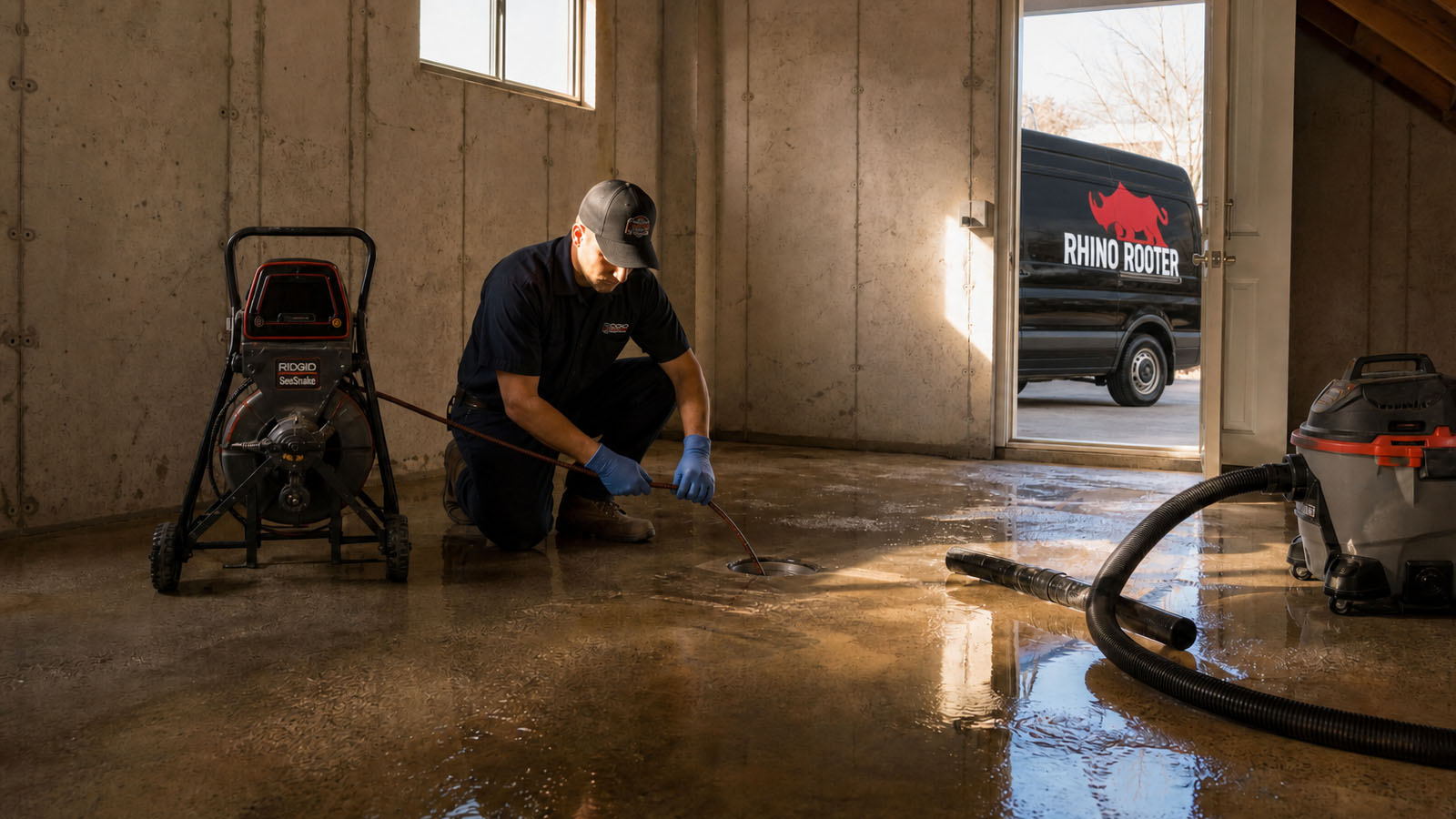
The other defining characteristic of a main line backup is where the wastewater appears. Because water follows gravity, it always seeks the lowest available exit. In a main line backup, water typically surfaces first at the basement floor drain, the utility sink, or the lowest shower in the home — before working its way up to higher fixtures as the blockage worsens.

Pro tip: Run this quick test: turn on a faucet on the upper floor of your home and watch the basement floor drain. If water appears at the floor drain within a minute or two of running the upstairs faucet, your main sewer line has a significant obstruction. Stop using water and call a plumber.

What Are the Most Common Causes of a Main Sewer Line Backup?

A camera inspection reveals which of these is actually at work in your pipe. Here are the seven causes Rhino Rooter finds most frequently in Weber County homes, along with the diagnostic clues that point to each.

1. Tree Root Intrusion

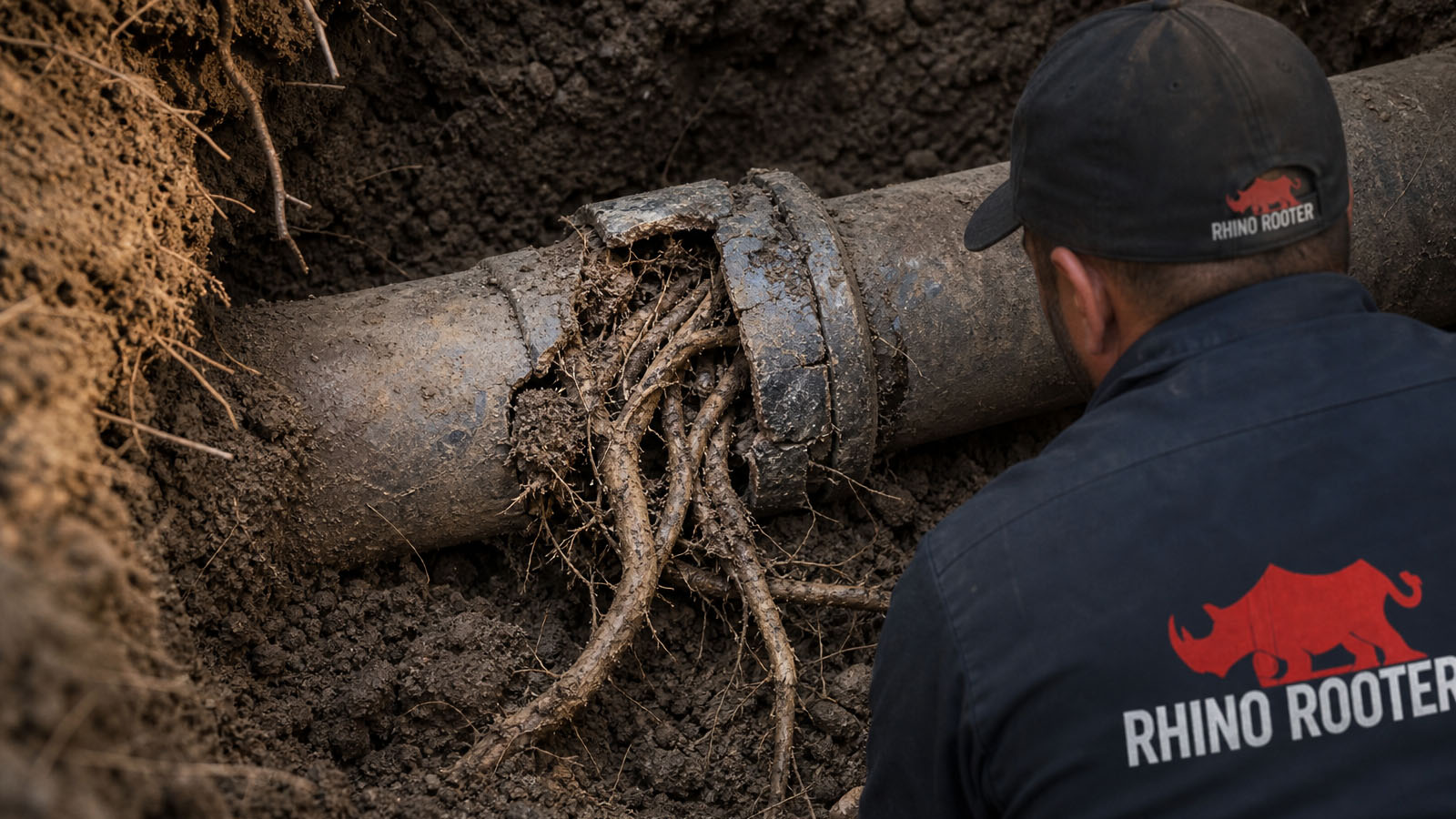
Tree roots are the leading cause of main line backups in Ogden and Weber County. Cottonwoods, box elders, and elms — common throughout Northern Utah’s established neighborhoods — push aggressive root systems toward any source of moisture. Your sewer lateral, carrying warm nutrient-rich wastewater just a few feet below your yard, is exactly what those roots seek out.

Roots enter through cracked joints, imperfect seams in clay tile pipe, or the connection point between your lateral and the city main. Once inside, they grow until they form a mass that catches debris and eventually blocks flow completely. The backup typically progresses gradually — slow drains first, then recurring clogs, then full backups.

How to tell: recurring backups despite repeated clearing, slow drains that return within months of snaking, and lush green patches or soggy ground in the yard above the sewer line. The only confirmation is a camera inspection.

2. Grease and FOG Buildup

Fats, oils, and grease — collectively called FOG — are poured down kitchen drains daily in most homes. Hot grease flows easily but cools and solidifies as it moves through the pipe, binding to the pipe walls and narrowing the interior diameter over time. In Weber County, where hard water (ranging from 200 to over 300 parts per million) accelerates mineral scaling, FOG and scale can combine to dramatically restrict flow within a few years.

Unlike root intrusion, FOG buildup tends to cause progressively slower drains before a full backup — and it’s concentrated in the section of line nearest the kitchen. The problem is compounded by people flushing so-called ‘flushable’ wipes, which don’t break down and snag on FOG deposits, accelerating blockage formation.

How to tell: slow drains that get progressively worse over months, gurgling near the kitchen sink before other parts of the house are affected, and backups that occur during or after heavy kitchen use.

3. Pipe Belly (Sagging Section)

A pipe belly is one of the most underdiagnosed causes of recurring sewer backups. It occurs when a section of your lateral sags below the surrounding pipe, creating a low spot where wastewater pools instead of flowing continuously toward the city main. A properly functioning sewer line runs at a consistent downward slope — typically a quarter inch of drop per foot of pipe — so gravity carries everything through. When that slope is interrupted by a belly, waste and solids collect in the low spot and build up into a blockage over time.

In Weber County, pipe bellies are common in older neighborhoods because the underlying soil shifts with every freeze-thaw cycle. Utah winters repeatedly freeze and thaw the ground, and the clay-heavy soil in the Weber River valley expands and contracts with seasonal moisture changes. That movement gradually undermines the compacted soil that supports the pipe, allowing sections to settle.

How to tell: recurring backups that happen even without an obvious clog — no flushed foreign objects, no grease event — and that return quickly after clearing. A camera inspection will show standing water in the low section even when no blockage is visible. A belly cannot be fixed by cleaning; it requires excavation and pipe replacement or re-sloping.

4. Collapsed or Offset Pipe

When a section of sewer pipe partially or fully collapses, or when pipe sections shift and become misaligned at the joints, waste has no clear path to the city main. This is most common in clay tile and cast iron pipe that has been in the ground for 50 or more years — both of which are widespread in Ogden’s pre-1970 neighborhoods. Soil movement, tree root pressure, and simple material degradation can all cause sections to crack, cave, or separate at joints.

A partially collapsed section may allow some flow with slow drains for months before fully failing. A fully collapsed section causes immediate, complete backup with no ability to restore flow through cleaning alone.

How to tell: sudden onset of backup with no recent change in habits, complete failure of multiple fixtures simultaneously, or a backup that cannot be cleared even with professional snaking. Only a camera confirms the extent of collapse.

5. Foreign Objects and Non-Flushable Items

Paper towels, ‘flushable’ wipes, feminine hygiene products, dental floss, children’s toys, and disposable cleaning pads are among the most common non-flushable items Rhino Rooter finds in blocked sewer laterals. Unlike toilet paper, which is designed to dissolve rapidly in water, these materials stay intact and accumulate. They catch on rough pipe interiors, at joint lips, or on existing partial blockages — and build into a dense obstruction over time.

How to tell: backup that began shortly after a high-usage event (holiday gatherings are common), or a household with young children who may have flushed objects. A camera inspection will show the exact material and its location in the line.

6. Heavy Rain and Municipal Sewer Overload

Weber County’s spring snowmelt and summer thunderstorms can overwhelm municipal sewer capacity. When the city main that your lateral connects to becomes overloaded with stormwater and runoff, the pressure can push sewage backward through your private lateral and into your home through the lowest fixtures. This type of backup has nothing to do with your pipe’s condition — your pipe is fine, but the city’s system is temporarily overloaded.

How to tell: backup occurs during or immediately after heavy rain or rapid snowmelt, neighbors report the same problem at the same time, and the backup clears on its own once the municipal system drains. A backflow prevention valve installed on your lateral is the only effective protection against this type of backup.

Weber County note: Spring snowmelt from the Wasatch Range creates the highest risk period for rain-related sewer overload in Ogden and surrounding communities. If your lowest floor drain backs up every spring, a backflow valve is worth serious consideration.

7. Aging Pipe Deterioration

Most homes in Ogden and Weber County’s established neighborhoods were built between 1910 and 1970. The sewer laterals installed during that era used clay tile pipe — porous, brittle, and installed in short sections with joints that were sealed only with oakum and mortar. After 50 to 100 years in Weber County’s shifting soil and freeze-thaw climate, many of these pipes have developed widespread cracking, joint separation, and interior scale buildup from hard water minerals.

Deteriorated clay pipe doesn’t fail all at once. It gets progressively worse as cracks widen, joints shift further apart, and the rough interior surface traps more debris. Recurring backups in a pre-1970 home with no obvious cause — no visible roots on camera, no foreign objects — often come down to pipe material that has simply reached the end of its functional life.

How to tell: the home was built before 1970, there’s a history of recurring sewer problems, and camera inspection shows widespread cracking or joint separation throughout the lateral rather than an isolated blockage.

Why Are Weber County Homes at Higher Risk for Certain Types of Backups?

Several factors specific to Northern Utah make main line backups more common in Ogden and surrounding communities than in newer-construction areas:

  • Clay tile pipe: Most homes built before 1970 in Ogden, Roy, Clearfield, and South Ogden have clay tile sewer laterals. Clay is porous, brittle, and prone to joint separation — the opposite of modern PVC, which is smooth, continuous, and root-resistant.
  • Freeze-thaw cycling: Utah winters subject buried pipes to repeated ground movement as soil freezes and expands, then thaws and contracts. Every cycle stresses pipe joints and can gradually shift sections out of alignment, creating bellies and offset joints.
  • Hard water: Weber County’s water supply ranges from 200 to over 300 parts per million in mineral hardness — among the harder municipal supplies in Utah. That mineral load deposits calcium and magnesium scale on pipe interiors with every gallon that flows through, narrowing pipe diameter and trapping debris.
  • Mature tree canopy: Ogden’s established neighborhoods are lined with cottonwoods, box elders, and elms — all species with aggressive root systems that readily exploit clay pipe joints.

The combination of these factors means that a Weber County home with original clay pipe, mature trees in the yard, and decades of accumulated scale is significantly more vulnerable to main line backup than a newer home with PVC laterals in an area without mature trees.

Why Is a Camera Inspection the Only Reliable Way to Diagnose a Sewer Backup?

The seven causes described above produce overlapping symptoms. Slow drains and gurgling can come from roots, grease buildup, a pipe belly, or a partially collapsed section. Recurring backups after cleaning can mean roots are regrowing, a belly is refilling with sediment, or a cracked joint keeps catching debris. Without seeing inside the pipe, you cannot reliably distinguish between them — and choosing the wrong fix is expensive.

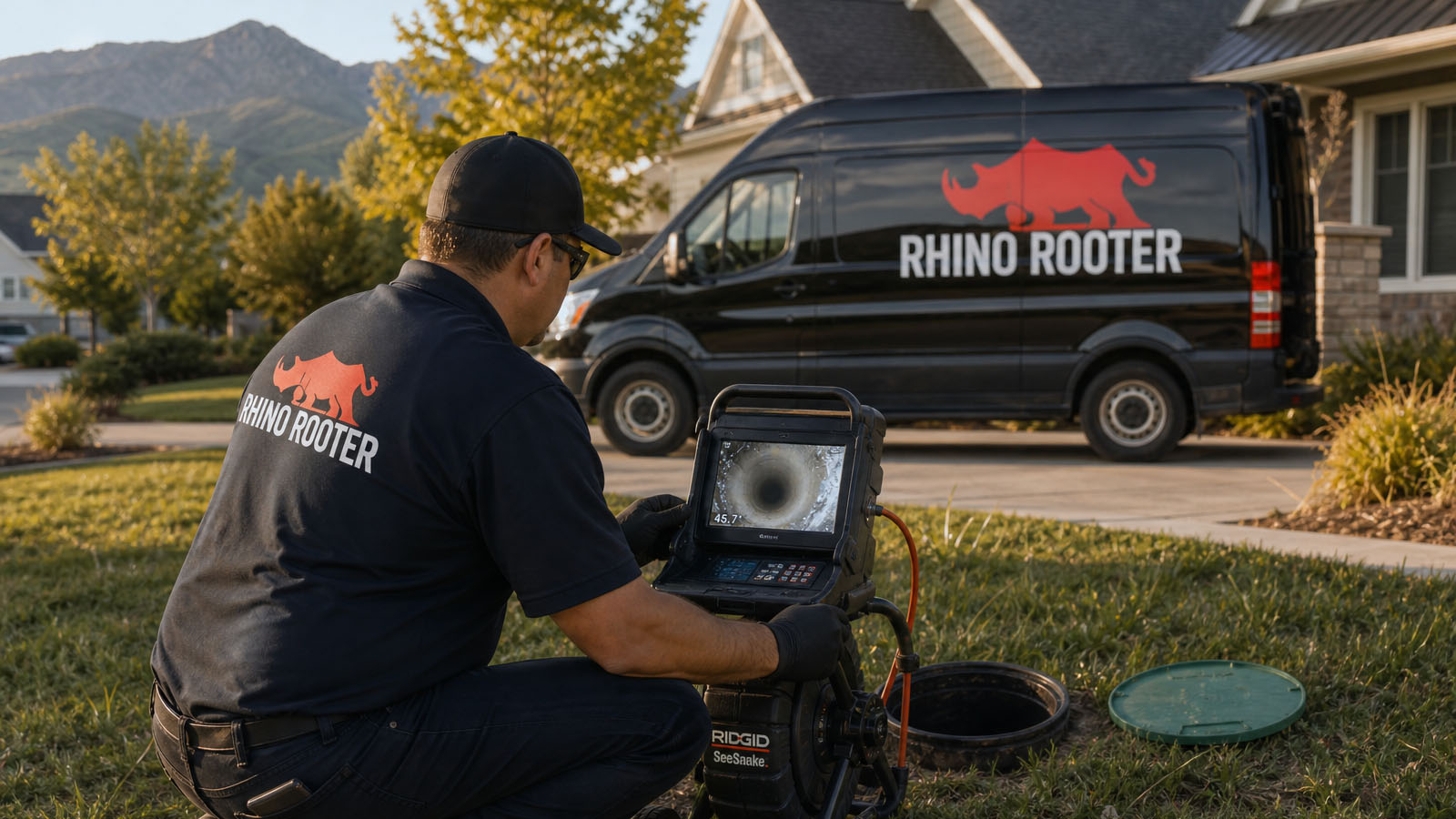
A camera inspection involves feeding a waterproof camera on a flexible cable through your sewer lateral via the cleanout access point. The camera transmits real-time footage showing the pipe’s interior condition, the exact location of any blockage or damage, and the pipe material. From that footage, a plumber can tell you:

  • Whether the obstruction is roots, grease, a foreign object, or structural damage
  • Whether the pipe is intact enough for trenchless repair or needs excavation
  • The exact distance from the cleanout to the problem — so the right section can be targeted
  • Whether there are multiple issues that need to be addressed together

Without camera confirmation, repeated snaking on a line with a pipe belly will clear the same blockage over and over without ever solving the problem. Hydrojetting a partially collapsed pipe can make it worse. The camera inspection is not an upsell — it’s the diagnostic step that prevents you from paying for the wrong fix.

What Should You Do Right Now If Your Sewer Is Backing Up?

  1. Stop using water immediately. Every flush, every faucet, every appliance adds more wastewater to a line that can’t carry it. The goal is to stop the water level from rising further.
  2. Don’t use chemical drain cleaners. They’re ineffective against main line blockages and can damage older clay and cast iron pipe. They also make the plumber’s job harder by contaminating the line.
  3. Don’t use a plunger on a main line backup. Plunging a single fixture when the main line is blocked can push sewage further into your home through other fixtures.
  4. Identify where the water is appearing. Multiple fixtures? Basement floor drain? Note which fixtures are affected and in what order — this information helps the plumber diagnose faster.
  5. Call Rhino Rooter. We serve Weber County 24/7 and can camera-inspect your line to identify the exact cause and recommend the right fix — not just the quickest patch.

TL;DR — Main Sewer Line Backup Causes at a Glance

  • A main line backup affects multiple fixtures simultaneously — that cross-fixture behavior is the defining sign.
  • The 7 most common causes: tree root intrusion, FOG/grease buildup, pipe belly, collapsed or offset pipe, foreign objects, municipal sewer overload from heavy rain, and aging pipe deterioration.
  • In Weber County, clay tile pipe, freeze-thaw soil movement, mature cottonwood and elm trees, and hard water make main line backups more common than in newer construction areas.
  • Snaking clears the immediate blockage but doesn’t fix the underlying cause — recurring backups after snaking are a strong signal to get a camera inspection.
  • A camera inspection is the only way to confirm the cause, choose the right fix, and avoid paying for a repair that doesn’t solve the real problem.
  • Call Rhino Rooter for a sewer camera inspection in Weber County — same-day service, honest diagnosis, and clear options with no pressure.

Frequently Asked Questions

How do I know if it’s my sewer line or the city’s main line that’s backed up?

If multiple fixtures inside your home are backing up at the same time, the problem is almost certainly in your private lateral — the pipe running from your house to the city main. If only your lowest fixtures are affected and neighbors are reporting the same issue simultaneously, the city main may be overloaded. In either case, stop using water and call a plumber. Rhino Rooter can camera-inspect your lateral and confirm whether the blockage is on your side of the connection point.

Why does my basement floor drain back up when I flush the toilet upstairs?

This is one of the clearest signs of a main line backup. When the main sewer line is partially blocked, wastewater from upper-floor fixtures has nowhere to go, so it follows gravity to the lowest available exit — which is usually the basement floor drain. If flushing a toilet upstairs causes water to appear at a floor drain, your main line has a significant obstruction and needs immediate inspection.

Can heavy rain cause a sewer backup even if my pipes are fine?

Yes, absolutely. In Weber County, spring snowmelt and summer thunderstorms can overwhelm municipal sewer capacity. When the city main is overloaded, that pressure can push sewage backward through your lateral and into your home through the lowest drain. This backup is not caused by any damage to your pipes — the city system is simply at capacity. A backflow prevention valve installed on your lateral is the most effective protection against this specific type of backup.

What is a pipe belly and why does it cause sewer backups?

A pipe belly is a low spot or sag in your sewer lateral where a section of pipe has settled lower than the surrounding sections. Sewer lines need to run at a consistent downward slope so gravity carries waste toward the city main. When a section sags, waste pools in that low spot instead of flowing through. Over time, solids accumulate in the belly and cause recurring blockages. A pipe belly can only be confirmed with a camera inspection and typically requires excavation to re-slope or replace the affected section.

Why does my sewer backup keep coming back even after I get it snaked?

Snaking clears the immediate blockage but doesn’t address the underlying cause. If your line has tree root intrusion, a pipe belly, cracked joints, or heavy grease buildup, the same conditions that created the last backup are still there — and will create the next one. Recurring backups after snaking are a strong signal that a camera inspection is overdue. Until you know what’s actually causing the problem, snaking is only buying time between emergencies.

Related Guides

Sewer Backing Up in Weber County? Here’s Your Next Step

A main sewer line backup isn’t a problem that gets better on its own. Every hour water continues backing up into your home increases the damage — to your floors, your walls, your belongings, and your family’s health. And every time you get it snaked without diagnosing the cause, you’re delaying the real fix and likely making the underlying problem worse.

Rhino Rooter serves Weber County with same-day sewer camera inspections, drain cleaning, hydrojetting, CIPP lining, and full sewer repair and replacement. We show you the camera footage, explain exactly what we found, and give you clear options — with honest recommendations about what your pipe actually needs.

Contact Rhino Rooter today: https://rhinorooter.net/contact 

About Rhino Rooter  |  Rhino Rooter is a Northern Utah sewer and drain specialist serving Weber County, including Ogden, Roy, Clearfield, South Ogden, and surrounding communities. From sewer camera inspections to CIPP pipe lining, hydrojetting, and emergency sewer repair, Rhino Rooter delivers honest diagnosis and lasting solutions to Northern Utah homeowners.

Related posts